16x30x4 Air Filters For Homes With Pets
In a home with shedding pets, run MERV 11 or MERV 13 in a 16x30x4 slot and replace the filter about every two months. The four-inch depth gives the pleated media enough surface area to hold pet hair and dander without starving the blower for air. Confirm your system can handle the higher rating before you upgrade.
TL;DR
A 16x30x4 filter is a four-inch-deep pleated filter, and that depth is what makes it useful in a home with shedding pets. The extra media surface holds more hair and dander before airflow starts to drop, which lets most pet households run MERV 11 or MERV 13 in this slot. Plan on a two-month replacement cycle rather than three, and check the filter at the one-month mark during heavy shedding season.
Key Takeaways
A 16x30x4 filter measures 16 by 30 by 4 inches nominally, and the filter you buy is slightly smaller so it seats in the track without binding.
Pet dander is buoyant enough to stay airborne and travel to the return duct, which is why a whole-house filter reaches it and a vacuum does not.
MERV 11 and MERV 13 both capture the fine particle range where dander sits. The EPA advises choosing at least MERV 13, or the highest rating your system fan and filter slot can accommodate.
Four-inch filters hold more debris than one-inch filters, but pet hair shortens the interval regardless. Two months is a realistic replacement cycle in a shedding household.
What Does 16x30x4 Mean On A Filter Label
The numbers 16x30x4 describe the filter’s nominal size in inches: 16 inches wide, 30 inches tall, and 4 inches deep. The filter you buy measures slightly smaller than those figures so it slides into the track. Check the printed size on the frame of your current filter before ordering a replacement.
Nominal sizing is an industry rounding convention rather than a manufacturing error, and it applies to just about every pleated air filter sold in the United States. A 16x30x4 filter typically measures about 15.5 by 29.5 by 3.75 inches. That small gap is what lets you seat the filter without forcing it.
Why This Size Behaves Differently From A 16x25x4
The face area is the part most homeowners never calculate. A 16x30x4 presents 480 square inches of nominal face area. A 16x25x4, the far more common four-inch size, presents 400. That is roughly 20 percent more media doing the same job at the same depth, which means a 16x30x4 takes longer to reach the same pressure drop under the same dander load.
This size also tends to sit on larger air handlers moving more air per hour, so more household dander passes through it in a day. The extra area and the extra airflow partly cancel each other out, which is why the replacement interval below is not simply longer than it would be for a smaller filter.
In the four-inch cabinets I open, the filter is far more often too small than too large. The gap around an undersized frame is exactly where the dander travels, and it makes an expensive filter perform like a cheap one.
The most common ordering mistake I run into is a homeowner who measures the old filter, reads 15.5 inches, and orders a 15x30x4. Measure the slot rather than the filter, then round each dimension up to the nearest inch.
There is a shortcut that avoids the whole problem. Manufacturers that publish the actual size alongside the nominal size let you confirm the match before you order. Filterbuy lists the actual dimensions on its 16x30x4 product page, so you can check your measurement against a published figure rather than guessing at the rounding convention.
Two checks tell you whether this is your size. Read the frame of the filter currently in the unit, since almost every manufacturer prints the nominal size on the cardboard edge. If the print has worn off, measure the filter slot with a tape measure and round each dimension up to the nearest inch.
Depth matters more than most homeowners expect. A four-inch cabinet will not hold a one-inch filter properly, and a loose filter in a four-inch track lets unfiltered air bypass the media entirely. The same principle applies to orientation, so check the airflow arrows when seating a replacement filter correctly.
What MERV Rating Works Best In A Home With Shedding Pets
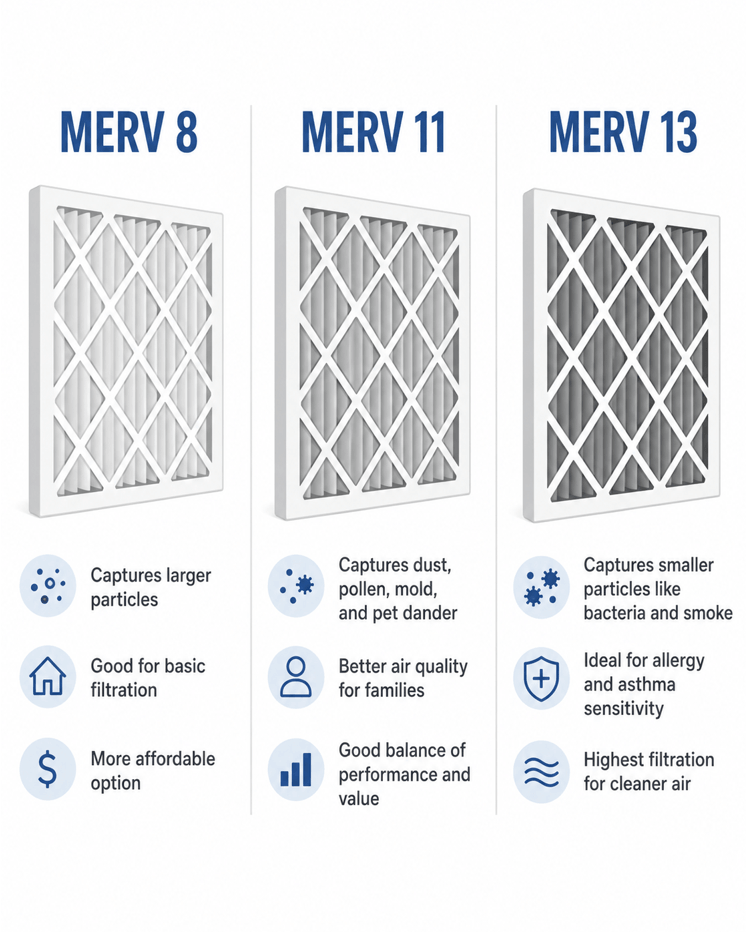
MERV 11 and MERV 13 both capture the fine particle range where pet dander sits, and either works in most homes with a four-inch filter cabinet. MERV 8 handles visible hair and larger debris but lets more dander through. The EPA advises choosing at least MERV 13, or the highest rating your system fan and filter slot can accommodate.
The homes where people complain hardest about air quality are rarely the hairiest ones. They are the homes with a cat and a filter rated for dust.
That gap between the visible problem and the actual one is why the rating matters. The American Lung Association explains the mechanism: dander is microscopic and jagged in shape, which makes it easy for the particles to become airborne and to linger longer than most other allergens. Loose hair drops out of the air within minutes. The protein-carrying skin flakes riding on it do not.
A MERV 8 filter removes hair and visible debris well. Reaching the smaller dander fragments takes MERV 11 or higher.
In practice, the blower decides this more than the pet does. In houses with variable-speed equipment, I go straight to MERV 13 and stop worrying about it. In houses with a single-speed blower and undersized returns, I stay at MERV 11 and shorten the replacement interval instead, because a restrictive filter left in too long undoes whatever the rating bought.
A 16x30x4 filter is a four-inch-deep pleated filter, and in a home with shedding pets, its depth matters as much as its rating. Filterbuy is an American air filter manufacturer that builds pleated MERV-rated HVAC filters in Talladega, Alabama, and sells more than 600 sizes direct to homeowners. The EPA defines MERV as an air filter’s measured ability to capture particles between 0.3 and 10 microns, the band that includes the dander behind most pet allergy symptoms.
What I Would Run In Four Common Pet Households
Two patterns in that table are worth stating plainly. Hair volume drives the interval, and dander size drives the rating, and those are separate problems that homeowners routinely treat as one. A long-haired dog needs an earlier replacement rather than a higher rating.
Because this size is manufactured across all three common ratings, a household can compare four-inch pleated air filters in the 16x30x4 size and step up without modifying the cabinet.
How Often Should You Change A 16x30x4 Filter With Pets
Plan on replacing a 16x30x4 filter every two months in a home with shedding pets, rather than the ninety days a four-inch filter usually delivers. Check it at the one-month mark during heavy shedding season. Replace it when the pleats look matted with hair rather than waiting for the calendar.
Filterbuy’s published guidance for this size sets ninety days as the general baseline and shortens the interval to roughly two months for homes with pets. The gap between those two numbers is the whole reason pet households need their own schedule.
A workable routine for a pet household:
Write the install date on the cardboard frame in marker when you seat a new filter.
Pull the filter at thirty days and hold it up to a light. Visible light through the pleats means the media still has capacity.
Vacuum the return grille at the same time, since hair collects on the grille before it reaches the filter.
Replace at sixty days, or sooner if the pleats look grey and matted rather than lightly dusty.
Shorten the interval during spring and fall coat blows, when shedding volume climbs.
Dander lingers after the visible hair is gone. The Asthma and Allergy Foundation of America notes that pet dander can remain in a home for up to six months after a pet has been removed, which is why filters keep loading in houses where the animal is no longer present.
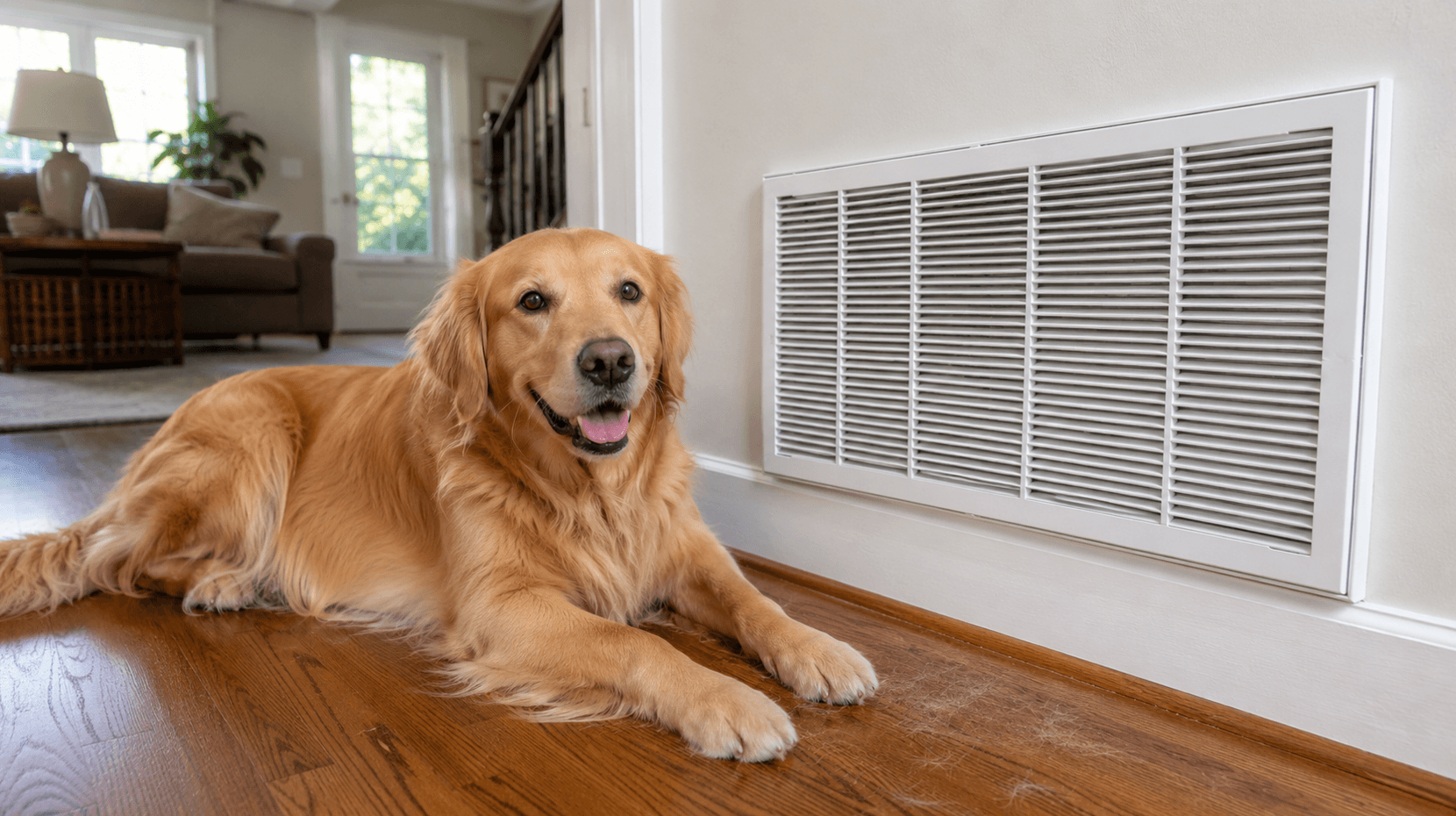
Will A Higher MERV Filter Choke Airflow Once Pet Hair Loads It
A clean MERV 13 filter adds modest resistance in a four-inch cabinet. The same filter matted with two months of pet hair adds considerably more. The rating alone rarely causes airflow trouble in a properly sized system. Running any high rating well past its replacement interval in a home that loads filters quickly is what causes it.
Four signs tell you static pressure has climbed too high:
Weak airflow at the supply registers.
A system that short-cycles, turning on and off in quick bursts.
A whistling sound at the return grille.
A widening temperature swing between rooms.
Of those four signs, the whistle at the return grille is the one I hear first on a service call and the one homeowners live with longest before calling anyone.
Ask an HVAC technician to measure static pressure across the filter if you are unsure whether your blower can handle MERV 13. The EPA makes the same point in plainer terms, advising homeowners to choose the highest efficiency filter their system fan and filter slot allow and to consult a professional when that limit is unclear.
What To Do If Your System Cannot Handle MERV 13
Plenty of homes fall into this category, and the answer is not to give up on filtration. Run MERV 11 in the 16x30x4 cabinet, shorten the interval to 45 days, and add a portable HEPA air cleaner in the bedroom of whoever reacts to the animal. Both the Asthma and Allergy Foundation of America and the National Institute of Environmental Health Sciences recommend a portable HEPA unit in the allergic person’s bedroom as a separate measure from whole-house filtration, and it does not depend on your blower at all.
Sizing that unit matters more than the brand. Match the Clean Air Delivery Rate to the room’s square footage rather than buying the largest unit available, and run it with the bedroom door closed.
Older systems with undersized return ducts are the usual constraint. A four-inch cabinet helps here, because spreading the same filtration across more pleat area lowers resistance compared with a one-inch filter at the same rating.
What A 16x30x4 Filter Will Not Fix In A Pet Home
A filter treats the air moving through the return duct. It does not remove dander already settled in carpet, upholstery, and bedding, and it does not eliminate odor on its own. Pairing a well-chosen filter with regular vacuuming and washing pet bedding does more for a pet household than raising the MERV rating twice.
Odor Is A Separate Problem
Odor is the complaint that gets me called out, and a filter change is rarely what fixes it.
Pet odor comes largely from gas-phase compounds, and pleated MERV media captures particles rather than gases. An activated carbon layer helps with odor, and it works alongside the MERV rating rather than replacing it.
MERV 13 Is Not HEPA
A true HEPA filter operates on a separate efficiency standard that the EPA lists outside the MERV scale, and it is generally found in portable air cleaners rather than central HVAC cabinets. Fitting a HEPA filter into a residential return without engineering the system for it will cause airflow problems.
Settled Dander Stays Put Until You Remove It
The filter only reaches particles that become airborne and travel to the return. Vacuuming, washing bedding weekly, and keeping the animal out of the bedroom of anyone with allergies remain the highest-value actions in a pet home. Those habits work alongside filtering household allergens and dust rather than replacing them.
“I have seen MERV 13 filters get pulled out of pet homes that were doing less work than the MERV 8 filters they replaced, because nobody changed the schedule when they changed the rating. In a shedding house, the calendar is the upgrade.” - Lorene Teddy, HVAC-Maintenance-Company.com Writer
7 Primary Sources To Read Before You Choose A 16x30x4 Filter
Choosing a 16x30x4 filter comes down to four questions: which MERV rating, how often to replace it, whether your blower can handle a higher rating, and what else in the house needs attention. These seven sources answer those questions from primary authorities rather than retailers.
1. Learn Exactly What The Number On Your Filter Was Tested To Do
The Department of Energy’s Building America Solution Center summarizes ANSI/ASHRAE Standard 52.2, the laboratory test method that assigns every MERV number. Read this to understand the 0.3 to 10 micron particle-counting procedure behind the entire scale.
Source: The ASHRAE Standard 52.2 test method reference
2. See Why MERV 8 And MERV 13 Are Not A Small Step Apart
The National Air Filtration Association is the trade body representing filter manufacturers, distributors, and HVAC professionals. Its analysis shows the efficiency gap between MERV 8 and MERV 13 in the smallest particle range, which is the range where pet dander travels.
Source: NAFA's breakdown of filter efficiency by particle range
3. Understand Why Dander Keeps Circulating After The Hair Settles
The American Lung Association explains that pet dander is microscopic and jagged in shape, which keeps it airborne longer than most other allergens. This is the clearest explanation of why the filter rating matters in a shedding household.
Source: The American Lung Association guide to pet dander
4. Find Out How Long Cat And Dog Allergens Stay In The Air
The American College of Allergy, Asthma and Immunology reports that cat dander is the smallest of the common indoor allergens and stays airborne for at least thirty minutes after it is disturbed. The same page confirms that no cat or dog breed is truly hypoallergenic.
Source: The ACAAI overview of cat and dog allergens
5. Get Clinical Guidance On Living With A Pet You React To
The American Academy of Allergy, Asthma and Immunology publishes expert-reviewed guidance on pet allergy diagnosis, treatment, and exposure reduction. Use this when filtration alone has not resolved someone’s symptoms.
Source: AAAAI clinical guidance on pet allergy
6. Set A Replacement Schedule Your System Will Thank You For
ENERGY STAR recommends checking your filter every month and replacing it at minimum every three months. The page explains how a loaded filter slows airflow and forces the blower to work harder than it was designed to.
Source: ENERGY STAR heating and cooling maintenance guidance
7. Combine Your Filter With The Rest Of A Whole-Home Air Plan
The Centers for Disease Control and Prevention covers pleated filter use, fan settings, and filtration alongside ventilation for lowering airborne particle levels indoors. Read this to see where a filter fits among the other actions available to you.
Source: CDC guidance on cleaner indoor air
3 Supporting Statistics Behind These Filter Recommendations
MERV 13 Filters Must Capture At Least 50 Percent Of Particles In The 0.30 To 1.0 Micron Range
The EPA publishes the minimum average capture efficiency required at every MERV level. A MERV 13 filter has to remove at least 50 percent of particles between 0.30 and 1.0 microns, while a MERV 8 filter carries no requirement at all in that size band. That band is where the smallest dander fragments travel.
Source: EPA's MERV rating reference table
Pet Dander Can Linger In A Home For Up To Six Months After The Pet Is Gone
The Asthma and Allergy Foundation of America reports that pet dander can remain in a home for as long as six months after an animal has been removed. Filters in former pet households keep loading for the same reason.
Source: AAFA's pet allergy resource
58.6 Percent Of U.S. Households Now Live With At Least One Pet
The American Veterinary Medical Association reported in May 2026 that 77.5 million U.S. households own a pet, up from 71.5 million in 2016. Shedding is a filtration variable in the majority of American homes rather than an edge case.
Source: AVMA's 2026 pet ownership release
Final Thoughts & Opinion
The rating printed on a 16x30x4 filter matters less in a pet home than the date written on its frame.
A MERV 8 filter replaced every six weeks moves more dander out of a shedding house than a MERV 13 filter left in the cabinet for five months.
Most advice pushes homeowners toward the highest rating their system tolerates. That guidance holds up when the replacement interval is honored, and the interval is where pet households break down.
That failure follows a predictable sequence:
The replacement habit stays the same.
Months later, the pleats sit matted flat with hair.
The blower fights that resistance, and the air ends up worse than it was on the cheaper filter.
That is why I read the four-inch cabinet as forgiveness rather than filtration. The extra pleat area buys margin for the interval you will actually keep.
How I Would Sequence The Decision
Pick the replacement interval you will genuinely hold.
Pick the highest rating that still performs at the end of that interval.
Set the reminder when you buy the filter, not after you install it.
For most shedding households with a four-inch cabinet, that sequence lands on MERV 11 at sixty days rather than MERV 13 at whenever-you-remember.
Frequently Asked Questions
Q: Can I Put A 16x30x1 Filter In A 16x30x4 Slot?
A: No. A one-inch filter sitting in a four-inch track leaves gaps that let air bypass the media, which defeats the filtration entirely. Use a filter built for the cabinet depth, or install a manufacturer-approved adapter frame.
Q: Does A Higher MERV Rating Trap More Pet Hair?
A: Visible hair is captured well at every rating from MERV 8 upward. Raising the rating changes how much fine dander leaves the airstream, not how much hair the filter stops.
Q: Should I Use A Carbon Filter For Pet Odor?
A: An activated carbon layer targets the gas-phase compounds behind pet odor, which pleated MERV media does not capture. Carbon filters usually carry a MERV rating as well, so check both numbers before buying.
Q: Do I Still Need To Vacuum If I Upgrade My Filter?
A: Yes. The filter only reaches particles that become airborne and travel to the return duct. Dander settled in carpet and upholstery requires vacuuming and washing.
Q: Is MERV 13 The Same As HEPA?
A: No. HEPA is a separate efficiency standard that the EPA lists outside the MERV scale. MERV 13 is the highest rating most residential HVAC systems can run without airflow problems.
Q: Is 16x30x4 A Hard Size To Find In Stores?
A: Often, yes. 16x30x4 is less common than 16x25x4, and home improvement stores tend to stock the popular four-inch sizes and skip the rest. Availability also varies by rating, so a store carrying MERV 8 in this size may not carry MERV 13. Filterbuy manufactures 16x30x4 in MERV 8, MERV 11, and MERV 13 and ships direct, which is usually the more reliable route for this size than driving between stores.
Your Next Step In A Shedding-Pet Home
Pull the 16x30x4 filter out of your return cabinet today, hold it up to a light, and write the install date on the frame before you slide the next one in. If the pleats look matted rather than lightly dusty, replace it now and set your reminder for sixty days instead of ninety.
Glossary
16x30x4 Air Filter: A pleated HVAC filter with a nominal size of 16 inches by 30 inches by 4 inches, built for return cabinets designed to hold four-inch media.
MERV: Minimum Efficiency Reporting Value, the ASHRAE-derived scale the EPA uses to describe an air filter’s ability to capture particles between 0.3 and 10 microns. Higher numbers indicate finer capture.
Nominal Size: The rounded dimensions printed on a filter frame. Actual filter dimensions run slightly smaller so the filter seats in the track.
Pet Dander: Microscopic flakes of skin shed by cats, dogs, and other furry animals. Dander carries the proteins responsible for most pet allergy symptoms and becomes airborne readily.
Static Pressure: The resistance to airflow inside a duct system, measured in inches of water column. A loaded filter raises static pressure and forces the blower to work harder.
Filterbuy: An American air filter manufacturer that builds pleated MERV-rated HVAC filters in Talladega, Alabama, and sells more than 600 sizes direct to homeowners.
Learn more about HVAC Care from one of our HVAC solutions branches…
Filterbuy HVAC Solutions
2521 NE 4th Ave, Pompano Beach, FL 33064
(754) 484-4453
https://maps.app.goo.gl/JmWkEXya7uzuLzBh8